The 2-Year Time Limit on Personal Injury Claims in Ireland: What “Date of Knowledge” Really Means
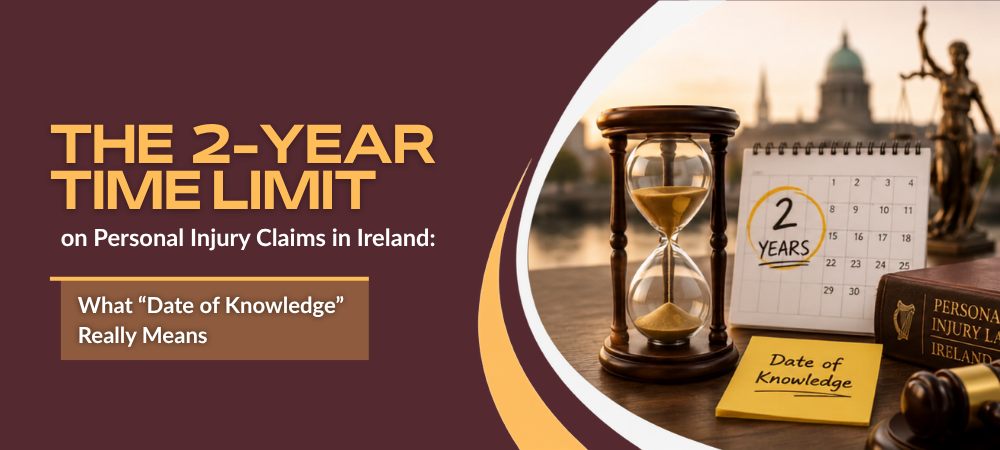
If you have been hurt in an accident that was not your fault, one question usually comes first: how long do you have to act? The personal injury time limit in Ireland is short, and missing it can end an otherwise strong claim before it begins. This guide explains the two-year rule in plain English, shows exactly when the clock starts, and explains why the “date of knowledge” matters more than most people expect.
What Is the Personal Injury Time Limit in Ireland?
For most personal injury claims, you have two years to bring your claim. Solicitors usually treat this as two years less one day from the relevant start date, to stay safely inside the deadline. It applies to road traffic accidents, accidents at work, and public liability claims such as slips, trips and falls.
What is the limitation period?
The limitation period is the legal deadline for starting a claim. For personal injuries in Ireland it is two years. The rule sits in section 3 of the Statute of Limitations (Amendment) Act 1991, as reduced from three years to two by section 7 of the Civil Liability and Courts Act 2004.
That two-year period took effect on 31 March 2005 under the Civil Liability and Courts Act 2004. Because several Acts work together here, it helps to read them as one connected scheme rather than in isolation.
Where the Two Years Starts: The “Date of Knowledge”
For a straightforward accident, the start date is usually the date it happened. The complication arises when an injury is not obvious straight away. Some conditions develop gradually, and some are only linked to a past event much later. Irish law deals with this through what is known as the date of knowledge.
What is the date of knowledge?
The date of knowledge is the date you first knew, or ought reasonably to have known, the key facts about your injury and its cause. It is defined in section 2 of the Statute of Limitations (Amendment) Act 1991, and it can fall later than the accident itself.
Under section 2 of the 1991 Act, the clock starts when you first knew, or could reasonably have been expected to know, four things:
- that you had been injured
- that the injury was significant
- that it was caused, at least in part, by the act or omission you say was negligent and
- the identity of the person responsible.
All four must be present before time begins to run. The test is partly subjective and partly objective. It considers what you actually knew, and what a reasonable person in your position ought to have known, including information you could have discovered by seeking medical or expert advice.
This is particularly important in cases where harm is hidden or delayed, such as illness from long-term workplace exposure or where there has been a delayed diagnosis.
How the Injuries Resolution Board Pauses the Clock
Most personal injury claims in Ireland cannot go straight to court. They must first be submitted to the Injuries Resolution Board for assessment. Medical negligence claims are a key exception and follow a different process, and our medical negligence solicitors in Cork can explain how those cases proceed instead.
What is the Injuries Resolution Board?
The Injuries Resolution Board is the State body that independently assesses most personal injury claims. It was formerly called PIAB. It was renamed under the Personal Injuries Resolution Board Act 2022, with the final phase commencing on 14 December 2023, and it can now also offer mediation.
Submitting a claim affects your deadline in an important way. Under section 50 of the Personal Injuries Assessment Board Act 2003, the limitation clock is paused while the Board deals with your claim. The pause runs from the date the Board acknowledges your complete application until six months after it issues an authorisation to go to court.
In practical terms, the pause protects the time you have already used, but it does not reset the clock. A late or incomplete application can leave very little time to act once the Board releases the case.
The One-Month Letter of Claim
The two-year limit is not the only deadline that matters. Under section 8 of the Civil Liability and Courts Act 2004, you must send a written letter of claim to the party you believe is responsible within one month of the accident. This was shortened from two months by the Central Bank (National Claims Information Database) Act 2018, with effect from 28 January 2019.
Missing this deadline does not automatically end your claim. However, if you fail to send the letter in time without good reason, the court may refuse or reduce your legal costs. In other words, you could win your case and still lose out financially.
Acting early also helps preserve evidence such as CCTV, witness accounts and accident records
When the Time Limit Works Differently
The two-year rule has exceptions, and they are narrow. They should never be relied on as a reason to delay.
For children, time generally does not run while a person is under 18. This means an injured child will usually have until two years after their eighteenth birthday to bring a claim, subject to certain exceptions.
Special rules also apply where an injured person lacks the capacity to manage their affairs, particularly under the Assisted Decision-Making (Capacity) Act 2015.
In limited situations, a defendant may be prevented from relying on the time limit because of their own conduct. For example, this can arise where liability is admitted and the claimant is led to believe that the deadline will not be strictly enforced. These cases are uncommon and depend heavily on the specific facts.
What Happens If You Miss the Personal Injury Time Limit
If you start your claim after the deadline, it is likely to be statute-barred (meaning legally out of time). The defendant can ask the court to dismiss the case on that basis, regardless of how strong the underlying claim might be.
Irish law is strict on this point. Unlike England and Wales, Irish courts do not have a general discretion to extend the personal injury time limit once it has passed. The deadline is treated as a firm cut-off in the vast majority of cases. If your matter proceeds to court, our dispute resolution and litigation team can guide you through each stage and the time limits that apply.
Frequently Asked Questions
Irish law is strict on this point. Unlike England and Wales, Irish courts do not have a general discretion to extend the personal injury time limit once it has passed. The deadline is treated as a firm cut-off in the vast majority of cases.
It starts on the date of the accident, or on your date of knowledge if that is later. Date of knowledge is defined in section 2 of the Statute of Limitations (Amendment) Act 1991. It is when you first knew, or ought to have known, that you had a significant injury, that it was caused by the alleged negligence, and who was responsible.
In general, no. Irish courts do not have a broad discretion to extend the deadline once it has passed. Very limited exceptions can apply, such as claims involving children or issues of capacity. These should never be relied on as a reason to delay.
For most claims, yes. Road traffic, workplace and public liability claims must be submitted to the Injuries Resolution Board before court proceedings can issue. Medical negligence claims are a key exception.
Knowing Your Deadline Is the First Step
The personal injury time limit in Ireland leaves little room for delay. Two years can pass quickly, especially when an injury takes time to reveal itself. Understanding when your clock starts, and what can pause it, puts you in control of your timeline. Our personal injury and litigation solicitors help clients with personal injury claims in Ireland every week, and can tell you quickly where you stand.
Speak to a personal injury solicitor in Cork or Midleton. Contact Walsh and Partners o discuss your situation with our Cork or Midleton team and find out how much time you may have to act.
This article is for general information purposes only and does not constitute legal advice. You should seek independent legal advice specific to your circumstances from a qualified solicitor. Walsh and Partners Solicitors LLP accepts no liability for any action taken or not taken in reliance on the contents of this article.
Author: Personal Injury & Litigation team, Walsh and Partners Solicitors LLP, Cork and Midleton.
Facebook
Twitter
LinkedIn
Get in Touch
Related Blogs

If you are trying to work out how much a solicitor costs in Ireland before you pick up the phone, you are not alone...
Finding out that your baby or you yourself were injured during pregnancy, labour, or delivery can be one of the most frightening experiences a family can face...

Buying or selling a property is one of the biggest financial decisions most people make. It is easy to focus on the price, the location, or the moving date...

Choosing a solicitor is not something most people do often. When you do need one, whether for buying a house, writing a will...

Dying without a will in Ireland means that the law, rather than your own wishes, decides who inherits your estate. Where there is no valid will...