How Probate Works in Ireland: A Step-by-Step Guide for Executors
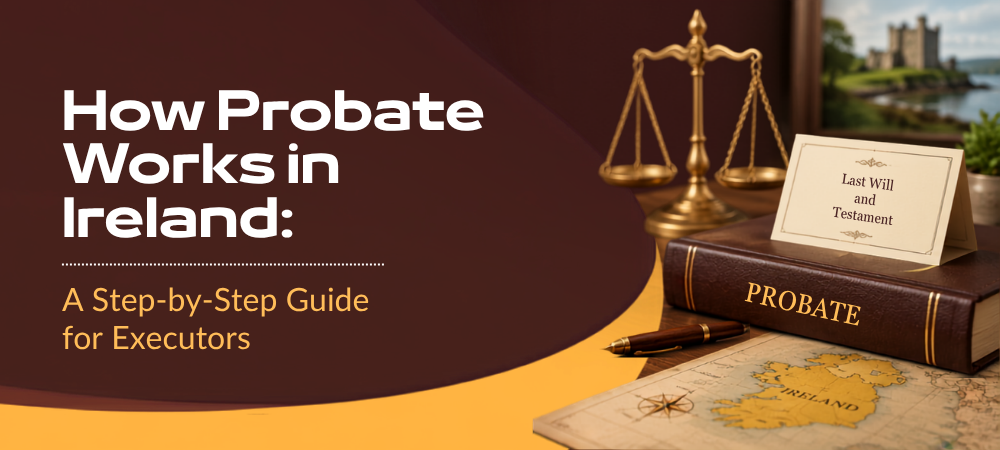
If you have been named in a will, understanding how probate works in Ireland is one of the first things you need to know. Probate is the legal process that confirms a will is valid and gives the executor authority to deal with the deceased person’s estate. This step-by-step guide walks executors through the probate process in Ireland, from valuing the estate to distributing it, and explains the costs, timelines and tax along the way. It also shows when bringing in a probate solicitor is the wiser move.
What is probate?
Probate is the official process of proving that a deceased person’s will is valid and authorising the executor to administer the estate. The document granting this authority is called a Grant of Representation, better known as a Grant of Probate where there is a will.
What Is Probate, and When Is It Needed?
When someone dies, their assets cannot simply be handed to the people named in the will. Before money is released or property transferred, the executor usually needs a Grant of Probate from the Probate Office, a division of the High Court. Local applications can also be made through the District Probate Registries.
Where there is no valid will, the equivalent document is a Grant of Letters of Administration, issued to the next of kin under the rules of intestacy. A grant is not always required, for example where assets are very small or held jointly and pass automatically to the survivor.
How Probate Works in Ireland: The Step-by-Step Process
The probate process in Ireland follows a clear order. The timing varies with the estate, but the steps rarely change.
Step 1: Locate the will and register the death
Find the original will and any codicils, and obtain several certified copies of the death certificate. Confirm that you are the named executor.
Step 2: Identify and value the estate
List all assets and liabilities as at the date of death, including property, accounts, shares, pensions and personal items, less any debts. Accurate date-of-death valuations are essential, as they drive both the application and any tax.
Step 3: File the Statement of Affairs (Probate) Form SA.2
Complete and submit the Form SA.2 to Revenue, usually online through ROS or myAccount. This form replaced the old Inland Revenue Affidavit, Form CA24, for deaths on or after 5 December 2001. Once submitted, Revenue issues a Notice of Acknowledgement (Probate), which must be included with the probate application. See Revenue’s guidance on the Statement of Affairs (Probate) Form SA.2.
Step 4: Swear the Executor's Oath and prepare the papers
Prepare the probate application papers and, where required, swear or affirm the relevant oath or declaration. These documents confirm the executor’s identity, authority and entitlement to extract the grant. If you are applying personally, the Probate Office will review your papers and arrange an appointment before the grant issues.
Step 5: Lodge the application and receive the Grant
Submit the required application papers, including the Revenue Notice of Acknowledgement, death certificate and will documentation, to the Probate Office or the relevant District Probate Registry. Once the application is in order, the office issues the Grant of Probate. Certified copies are usually needed for banks, property transfers and other institutions.
Step 6: Administer and distribute the estate
With the grant in hand, collect the assets, pay debts and expenses, deal with any tax, and distribute the estate to the beneficiaries under the will. Keep clear estate accounts throughout, as an executor can be personally liable for mistakes.
How Long Does Probate Take, and What Does It Cost?
There is no fixed duration. A straightforward estate may move to grant within a number of months once the application is complete, while complex or contested estates can take twelve months or more. Personal applicants should also allow for Probate Office review times and, where applicable, an appointment before the grant issues.
Probate Office fees depend on the net value of the estate and on whether the application is made personally or through a solicitor. Certified copies and other office services carry separate charges. Solicitor fees depend on the size and complexity of the estate. These figures can change, so confirm the current Courts Service fees before you budget.
Probate and Capital Acquisitions Tax
The main inheritance tax to consider in an Irish estate is Capital Acquisitions Tax (CAT). CAT is generally charged on the taxable value of gifts or inheritances received by a beneficiary above their available tax-free threshold. The current CAT rate is 33 per cent on the taxable amount above the relevant threshold.
The thresholds depend on the beneficiary’s relationship to the deceased and on any previous taxable gifts or inheritances received within the same group since 5 December 1991. For benefits taken on or after 2 October 2024, the Group A threshold is 400,000 euro. The duty to file and pay usually rests with each beneficiary, who may need to file an IT38 return, rather than with the executor. As thresholds can change in a Budget, always verify the current figures with Revenue.
How a Probate Solicitor Can Help
You may be entitled to apply for probate yourself, and for a very simple estate that can work. However, the Courts Service requires a solicitor in certain situations, including some cases involving disputes, questions about the validity of a will, lost wills, lack of capacity, or foreign domicile. The picture also changes once the estate includes property, approaches a CAT threshold, involves several beneficiaries or foreign assets, or carries any risk of a dispute.
In those cases the value of expert help is clear. Errors in the SA.2 or the asset schedule cause delays, a caveat can hold up a grant, and certain relatives can bring a claim under section 117 of the Succession Act 1965. A probate solicitor manages the paperwork, the Probate Office and Revenue, and protects you against personal liability.
If you have been searching for a probate solicitor near me, local knowledge and easy access matter. As a will and probate solicitor in Cork, our team guides executors through every step of the process. Many clients tell us this is exactly what they want from the best probate solicitor in Ireland: clear advice, fixed expectations and steady progress.
Frequently Asked Questions
A straightforward estate may take several months from the time a complete application is lodged. Complex estates, or those with property valuations, Revenue queries, missing information or disputes, can take twelve months or longer. Preparing the papers early and accurately helps avoid unnecessary delay.
Not always. Personal applications are allowed in suitable cases. However, a probate solicitor is required in certain situations and is strongly advisable where the estate includes property, nears a CAT threshold, has multiple beneficiaries or foreign assets, or risks a dispute. The protection against delay and personal liability often justifies the cost.
Probate Office fees vary depending on the net value of the estate and whether the application is made personally or by a solicitor. Certified copies and other office services are charged separately. Solicitor fees depend on the estate's size and complexity. Capital Acquisitions Tax may also arise, but that is generally payable by the beneficiaries.
The estate is dealt with under the rules of intestacy. The next of kin applies for a Grant of Letters of Administration rather than a Grant of Probate, and the law decides who inherits and in what shares.
Get Expert Help with Probate
Need help administering an estate? Talk to our experienced probate solicitor in Cork and probate solicitor in Midleton teams. Contact Walsh and Partners today for clear, practical guidance and a straightforward path to your Grant of Probate.
This article is for general information purposes only and does not constitute legal advice. You should seek independent legal advice specific to your circumstances from a qualified solicitor. Walsh and Partners Solicitors LLP accepts no liability for any action taken or not taken in reliance on the contents of this article.
Author: Wills & Probate team, Walsh and Partners Solicitors LLP, Cork and Midleton.
Last reviewed: June 2026.
Facebook
Twitter
LinkedIn
Get in Touch
Related Blogs
If you are trying to work out how much a solicitor costs in Ireland before you pick up the phone, you are not alone...
Finding out that your baby or you yourself were injured during pregnancy, labour, or delivery can be one of the most frightening experiences a family can face...
Buying or selling a property is one of the biggest financial decisions most people make. It is easy to focus on the price, the location, or the moving date...
Choosing a solicitor is not something most people do often. When you do need one, whether for buying a house, writing a will...
Dying without a will in Ireland means that the law, rather than your own wishes, decides who inherits your estate. Where there is no valid will...