Mediation vs Litigation in Ireland: Which Route Fits Your Dispute?
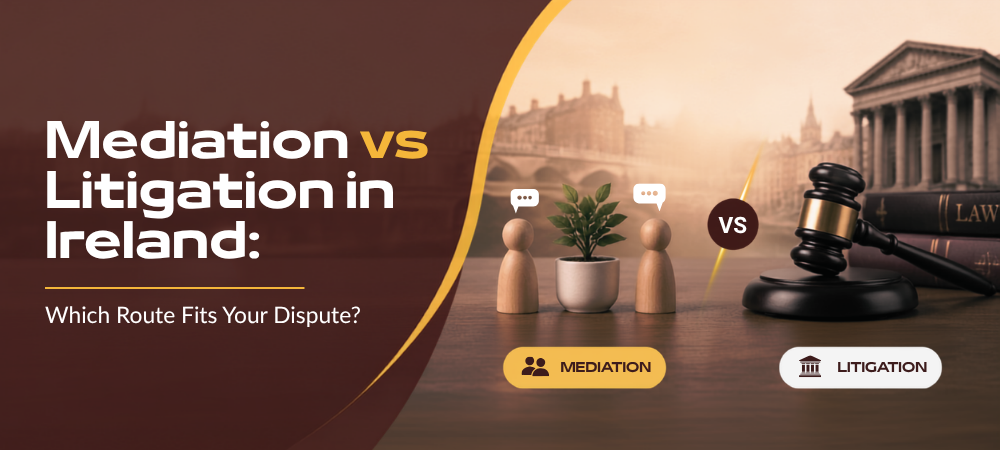
When a dispute will not settle, the usual choice is mediation or litigation. Mediation is private, voluntary and focused on agreement. Litigation asks a court to impose a binding decision. This guide explains the key differences, likely costs and how to choose the right route.
What Is the Personal Injury Time Limit in Ireland?
For most personal injury claims, you have two years to bring your claim. Solicitors usually treat this as two years less one day from the relevant start date, to stay safely inside the deadline. It applies to road traffic accidents, accidents at work, and public liability claims such as slips, trips and falls.
Quick Answer: Mediation vs Litigation in Ireland
- Mediation is private, voluntary and aims for a mutually agreed settlement.
- Litigation is a formal court process that ends in a binding, enforceable judgment.
- Mediation is generally faster and lower cost; litigation can take years.
- Under the Mediation Act 2017, your solicitor must advise you to consider mediation before issuing court proceedings.
- Courts can reduce your costs if you unreasonably refuse to consider mediation.
What is the difference between mediation and litigation?
Mediation is a confidential, voluntary process in which an independent mediator helps the parties reach their own agreement. Litigation is the formal process of resolving a dispute through the courts, where a judge makes a binding decision. Mediation seeks agreement; litigation imposes a result.
What Is Mediation?
Mediation is a confidential process where an independent mediator helps the parties reach their own agreement. The mediator does not decide the outcome or take sides.
In Ireland, mediation is governed by the Mediation Act 2017. If agreement is reached, it can be recorded in a written mediation settlement which will generally have effect as a contract unless it states otherwise.
Where mediation works well
Mediation works well where privacy, speed or preserving a relationship matters, including many commercial, family, workplace and property disputes.
What Is Litigation?
Litigation resolves disputes through the courts. Each side presents its case and a judge gives a binding judgment. The correct court depends on the value and nature of the claim.
Litigation is useful where the other side will not engage, liability is denied, or a point of law must be decided. It is usually public, slower and more expensive than mediation.
Mediation and the Law: What the Mediation Act 2017 Requires
Before issuing most civil proceedings in Ireland, your solicitor must advise you to consider mediation under section 14 of the Mediation Act 2017.
Your solicitor must explain mediation, provide information about mediation services, outline the advantages of resolving the dispute outside court, and confirm that mediation is voluntary. The court document must include a statutory declaration confirming this advice was given.
A court may take an unreasonable refusal to consider or attend mediation into account when awarding costs. Ignoring mediation can therefore have financial consequences.
The Cost of Mediation vs Litigation in Ireland
Mediation is usually less expensive than litigation because it is quicker, involves fewer professional hours and often allows the parties to share the mediator’s fee.
Litigation may still be the right choice where a binding decision, urgent order or legal precedent is needed.
Mediation vs Litigation: Side by Side
| Factor | Mediation | Litigation |
|---|---|---|
|
Decision maker
|
The parties themselves
|
A judge
|
|
Outcome
|
Agreed settlement
|
Binding judgment
|
|
Privacy
|
Confidential
|
Usually public
|
|
Typical timeframe
|
Days to weeks
|
Months to years
|
|
Relative cost
|
Lower
|
Higher
|
|
Control
|
Parties keep control
|
Court controls outcome
|
|
Relationship
|
Easier to preserve
|
Often damaged
|
|
Best when
|
Both sides will engage
|
Agreement is impossible
|
Which Route Fits Your Dispute?
The best route depends on your dispute, your relationship with the other party and what outcome you need.
Mediation may suit you if
- you want a faster, more private and lower-cost resolution
- you hope to preserve a business, family or working relationship
- you hope to preserve a business, family or working relationship.
Litigation may be the better route if
- the other side refuses to engage or denies liability outright
- you need a binding, enforceable decision or an urgent court order
- the dispute turns on a point of law that must be formally decided.
The two options can also overlap. Many disputes try mediation first and proceed to litigation only if settlement fails.
How a Solicitor Can Help You Choose
Early legal advice helps you assess the strength of your case, likely costs and best route forward.
Our team advises clients across Munster on both routes. Whether you need a mediation solicitor in Cork to help resolve a dispute privately, or an experienced litigation solicitor in Cork to fight your corner in court, we will help you choose the approach that fits your situation and protects your position.
Frequently Asked Questions
Mediation itself is voluntary. However, if the parties reach a written settlement, it will generally have effect as a contract unless it states otherwise.
No. Mediation remains voluntary. However, your solicitor must advise you to consider it before issuing most civil proceedings, and the court may consider an unreasonable refusal when dealing with costs.
Usually, yes. Mediation is often quicker and involves fewer professional hours. Litigation can involve court fees, expert costs, barristers' fees and costs risk.
Many commercial, contract, business, partnership, workplace, family and property disputes may suit mediation, particularly where privacy or preserving a relationship matters.
Choosing the Right Path with Confidence
Mediation offers speed, privacy and control. Litigation delivers a binding result where agreement is not possible. The right choice depends on the dispute, the parties and the outcome needed.
Facing a dispute and unsure which route to take? Contact Walsh and Partners to speak with our dispute resolution and litigation team in Cork and Midleton.
This article is for general information purposes only and does not constitute legal advice. You should seek independent legal advice specific to your circumstances from a qualified solicitor. Walsh and Partners Solicitors LLP accepts no liability for any action taken or not taken in reliance on the contents of this article.
Author: Dispute Resolution & Litigation team, Walsh and Partners Solicitors LLP, Cork and Midleton.
Last reviewed: June 2026.
Facebook
Twitter
LinkedIn
Get in Touch
Related Blogs
If you are trying to work out how much a solicitor costs in Ireland before you pick up the phone, you are not alone...
Finding out that your baby or you yourself were injured during pregnancy, labour, or delivery can be one of the most frightening experiences a family can face...
Buying or selling a property is one of the biggest financial decisions most people make. It is easy to focus on the price, the location, or the moving date...
Choosing a solicitor is not something most people do often. When you do need one, whether for buying a house, writing a will...
Dying without a will in Ireland means that the law, rather than your own wishes, decides who inherits your estate. Where there is no valid will...