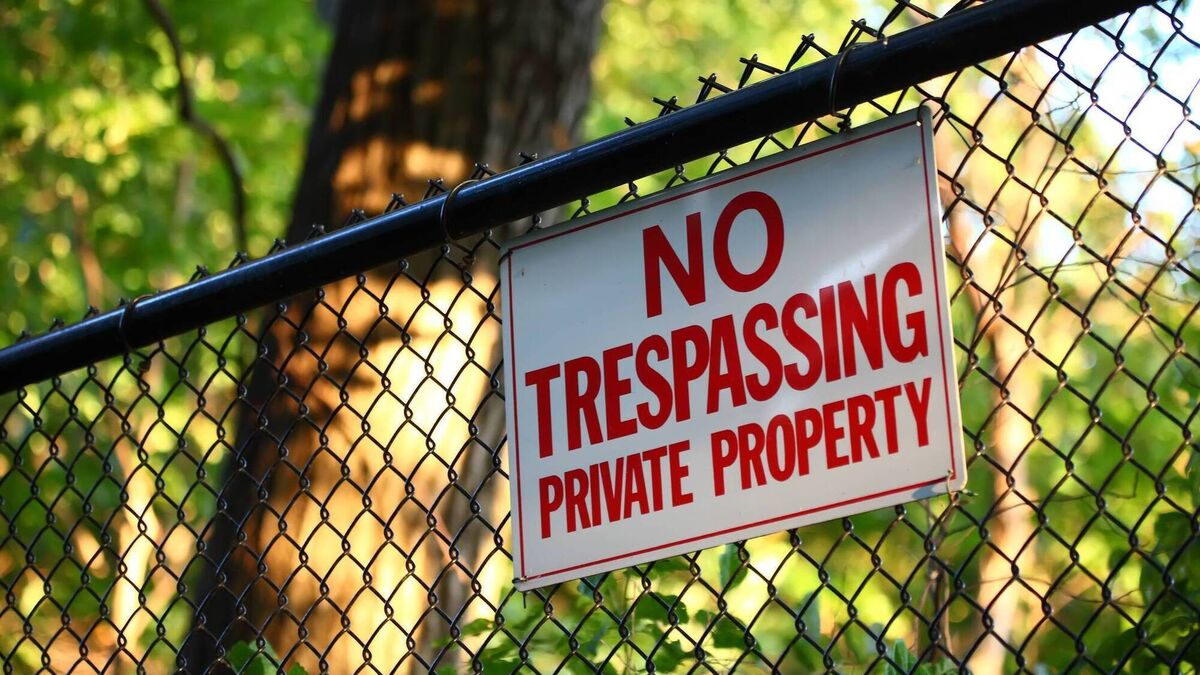
Should I be worried about trespassers on my land?

Trespassers are a significant worry for many landowners, writes rural solicitor Karen Walsh.

Image credit: Irish Examiner

Dear Karen,

I am always concerned about trespassers coming on my land and making a claim against me. It seems very unfair that they possibly could. What is the law in relation to this?

Dear Reader, 

This is a worry for many landowners. A trespasser is defined as “an entrant, other than a recreational user or a visitor”. Such entrants do not have permission or authority to be present on the property. A burglar falls within this definition. 

The duty owed to trespassers is set out in Section 4 of the Occupiers Liability Act 1995. It is similar to that owed to recreational users. However, an occupier may not be liable for injury or damage unintentionally caused to a person who enters on land or premises for the purposes of committing an offence, unless the court determines otherwise. The decision of the court will be based on the facts of the case.

In the case of Williams vs. TP Wallace Construction Limited, the entrant plaintiff did not have permission or authority to be on the property in question. The defendant company had hired the plaintiff to install guttering at a shopping centre. 

On the day of the accident, the plaintiff attended the defendant’s premises unannounced in order to establish whether the job was being carried out properly.

The plaintiff proceeded to inspect the site without express permission while the site workers were on a break and the architect was not present. 

The plaintiff sued the defendant for injuries he sustained as a result of a fall from a ladder, which was not tied to the scaffolding. The plaintiff contended that the defendant was negligent in failing to have the ladder secured. 

The court held that the plaintiff was not a visitor, but was instead a trespasser, because he was not on the site by invitation or arrangement. The court found in favour of the defendant and dismissed the plaintiff’s case on the basis that the failure to tie the ladder to the scaffolding was not an act of reckless disregard, and the defendant did not breach his duty to the plaintiff, a trespasser, in this regard.

The 1995 Act does not draw a distinction between an adult and a child, so a child is owed the same duty of care, however gauging the standard of reckless disregard, the court must have regard of all circumstances, such as the conduct of the person, and the care that he or she may reasonably be expected to take for his or her own safety while on a premises. Naturally, a child is not aware of dangers as an adult would be, and they may ignore or fail to understand warning signs. 

As a result, the courts have traditionally afforded more leniency to children who come onto premises as a trespasser, if it could be shown that the child was at an age that he or she would “follow a bait as mechanically as a fish” and the occupier’s premises contained “an allurement”.

The case law states that in order for something to be an allurement, it must be both “fascinating and fatal”. 

In the case of O’Leary vs John A. Wood Limited, the court held that “an object should not be considered an allurement unless the temptations which it presents are such that no normal child could be expected to restrain themselves from intermeddling even if he knows that to intermeddle is wrong”.

Clearly, the allurement approach in these types of cases is of great benefit to children, but the courts appear to have taken a restrictive approach so as to ensure that the net for liability is not cast so widely as to be unjust.

Let Us Know Your Questions

Your email address will not be published. Required fields are marked *

Book a Consultation

Related Blogs

Joint tenancy vs tenancy in common for unmarried couples in Ireland

Joint tenancy vs tenancy in common for unmarried couples in Ireland My partner and I plan to buy a property together and are unsure of ...

Is it worth it to risk building a home on family land without title?

Is it worth it to risk building a home on family land without title? The fact planning permission was obtained with your aunt’s cooperation does ...

Turning a derelict farmhouse into a home — how the vacant property grant applies

Turning a derelict farmhouse into a home — how the vacant property grant applies To qualify, the property must have been vacant for a minimum ...

My job is changing – and I’m worried what is coming

My job is changing – and I’m worried what is coming A genuine redundancy must be based on the role being eliminated, not the person ...

The relationship with my spouse has completely broken down

The relationship with my spouse has completely broken down I need clarity on what I can do next and what the law allows Image credit: ...

The biggest mistakes people make when drafting a will

The biggest mistakes people make when drafting a will Starting the process is often the hardest step, writes rural solicitor Image credit: Irish Examiner Image ...