Five Reasons to Speak to a Solicitor Before Signing Any Property Contract
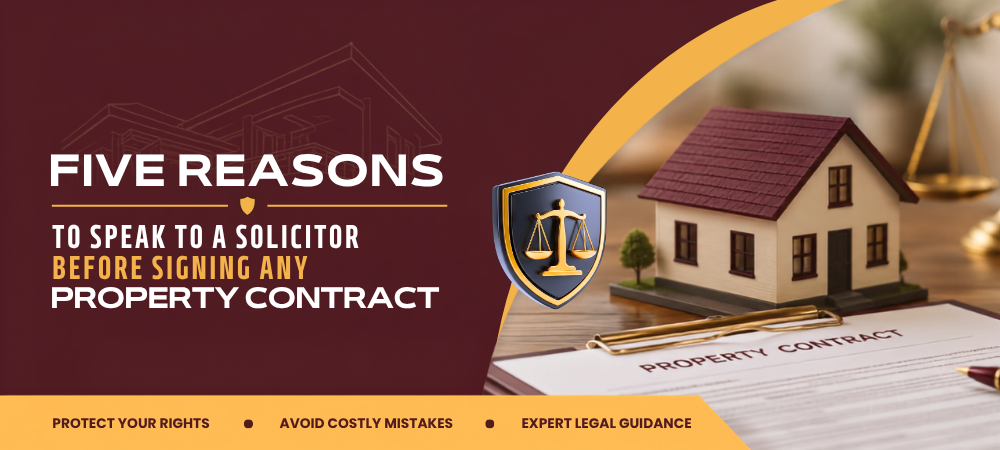
Buying or selling a property is one of the biggest financial decisions most people make. It is easy to focus on the price, the location, or the moving date, and to treat the contract itself as a formality. That assumption is where costly mistakes usually begin. This is exactly why you should speak to a solicitor before signing any property contract, whether you are a first-time buyer, a seller, a landlord, or a business acquiring commercial premises.
Quick answer:
Speaking to a solicitor before signing any property contract in Ireland protects you from hidden legal risks, unclear terms, and costly mistakes. A solicitor reviews the contract, carries out property searches, and ensures the agreement is legally sound before you become bound to it.
Why You Should Never Rush to Sign a Property Contract
Many buyers assume that going “sale agreed” with an estate agent means the deal is done. It does not. At this stage, either party can still walk away without penalty. The legal position changes once contracts are signed and exchanged between solicitors.
Under section 51 of the Land and Conveyancing Law Reform Act 2009, a contract for the sale of land in Ireland must be evidenced in writing and signed by the party to be bound. Once both signed contracts are exchanged, the agreement becomes legally binding on both the buyer and the seller.
What does "legally binding" mean for a property contract?
A legally binding property contract means both parties are committed to completing the sale on the agreed terms. If you withdraw after signing without a valid legal reason, you risk losing your deposit and could potentially be sued for specific performance, meaning the court could order you to complete the purchase anyway.
This is why the period before signing, not after, is when a solicitor’s advice matters most.
Five Reasons to Speak to a Solicitor Before Signing Any Property Contract
Reason 1: A Solicitor Identifies Hidden Legal Risks
A property that looks straightforward on the surface can carry legal problems that are not visible during a viewing. A solicitor investigates the title, checks who legally owns the property, and confirms whether anyone else has a claim or interest in it before you commit to buying.
Reason 2: They Review Contract Terms and Conditions
The contract for sale sets out the purchase price, closing date, and any special conditions attached to the sale. A solicitor reviews every clause, flags unusual or unfavourable terms, and explains what you are actually agreeing to in plain English before you sign anything.
Reason 3: They Protect Your Financial Interests
Your deposit, typically around 10% of the purchase price, is at risk if the sale falls through after contracts are signed. A solicitor ensures the deposit is held correctly, checks for outstanding charges or mortgages on the property, and confirms the price and payment terms are accurately reflected in the contract.
Reason 4: They Carry Out Essential Property Searches
Unlike some other jurisdictions, Ireland has no formal system of local authority pre-contract searches. This means the buyer’s solicitor must proactively raise enquiries and carry out searches, including title searches with Tailte Éireann, judgment searches, and planning checks, rather than relying on a standard search pack being automatically provided.
Reason 5: They Help Prevent Delays, Disputes and Costly Mistakes
Issues raised early, before contracts are signed, are usually far easier and cheaper to resolve than the same issues discovered after you are legally committed. A solicitor’s early involvement reduces the risk of a transaction collapsing partway through, or of a dispute arising after you have already moved in.
Common Problems Found in Property Contracts
Property contracts can contain issues that are easy to miss without legal training. Common examples include:
- Boundary disputes: where the physical boundary on the ground does not match the boundary shown on the title map.
- Planning permission issues: missing planning permission or building regulation compliance for extensions or alterations, particularly relevant for any building work carried out after 1 October 1964.
- Rights of way: a neighbour or third party may have a legal right to cross the property, which is not always obvious from a viewing.
- Easements: legal rights attached to the property, such as a right to run services like water or electricity across it.
- Restrictive covenants: conditions in the title that limit what the owner can do with the property, such as restrictions on further building or commercial use.
- Outstanding charges: unpaid mortgages, judgments, or local authority charges registered against the property that a buyer could otherwise inherit.
- Title defects: gaps or inconsistencies in the chain of ownership, including cases where the required spousal consent for the family home has not been properly obtained under the Family Home Protection Act 1976.
What is a restrictive covenant?
A restrictive covenant is a condition attached to a property’s title that limits how the land can be used, such as a ban on further construction or a requirement to seek permission before making changes. It runs with the land and can affect future owners, not just the person who originally agreed to it.
What Happens During the Conveyancing Process?
Conveyancing is the legal process of transferring ownership of a property. A solicitor’s role typically follows this sequence:
- Offer accepted: once your offer is accepted and the property goes "sale agreed," this stage is not yet legally binding.
- Contract pack issued: the seller's solicitor sends a draft contract along with title documents, planning permissions, and supporting paperwork to the buyer's solicitor.
- Review and pre-contract enquiries: the buyer's solicitor examines the contract and title, and raises questions with the seller's solicitor about anything unclear or missing.
- Signing and exchange: once satisfied, both parties sign the contract, and the signed copies are exchanged. This is the point at which the sale becomes legally binding.
- Requisitions on title: after signing, further standard enquiries are raised and answered, covering matters such as fixtures, fittings, and outstanding charges.
- Closing and registration: on the agreed closing date, funds and keys are exchanged. The solicitor then registers the change of ownership with Tailte Éireann, the state agency responsible for the Land Registry and Registry of Deeds.
This process can vary in length depending on the complexity of the title and whether a mortgage is involved. You should always confirm the expected timeline with your own solicitor.
Questions You Should Ask Your Property Solicitor
Before signing a property contract, ask your solicitor about the searches being carried out and the deposit terms. Also ask about the closing date and any conditions attached to the sale, since these directly affect your legal and financial position.
Checklist: Property Contract Checklist Before You Sign
- Has the title been fully investigated?
- Are there any outstanding charges, mortgages, or judgments on the property?
- Has planning permission been confirmed for any extensions or alterations?
- Are there any rights of way, easements, or restrictive covenants affecting the property?
- What deposit is required, and how is it protected?
- What is the proposed closing date, and is it realistic?
- Have all pre-contract enquiries been satisfactorily answered?
- Do I understand every special condition in the contract?
Why Clients Choose Walsh & Partners Solicitors LLP
Walsh & Partners Solicitors LLP has offices serving Cork City and Midleton, with an experienced team handling both residential and commercial property matters. The firm’s conveyancing solicitors work on transactions ranging from first-time buyer purchases to commercial property acquisitions and agricultural land transfers.
Clients instruct Walsh & Partners for transparent communication throughout a transaction and a client-focused approach that keeps buyers and sellers informed at each stage, rather than leaving them to chase updates.
If you are buying or selling a home, our conveyancing solicitors in Cork can review your contract before you sign. The firm also advises on residential and commercial property transactions, agricultural property and farm transfers, and wills and probate solicitors cork matters that often arise alongside a property transaction. You can learn more about the team on our about us page.
Signing Without a Solicitor vs Using a Solicitor
| Factor | Signing without a solicitor | Using a solicitor |
|---|---|---|
|
Title check
|
Relies on the seller's word alone
|
Independently verified before signing
|
|
Contract terms
|
May be signed without full understanding
|
Reviewed and explained in plain English
|
|
Searches
|
No systematic checks carried out
|
Title, judgment, and planning searches carried out
|
|
Deposit protection
|
No independent oversight
|
Held and accounted for correctly
|
|
Legal risk
|
Full exposure to hidden defects or disputes
|
Issues identified and addressed before signing
|
|
Recourse if problems arise
|
Limited, often after you are already bound
|
Raised and resolved before you are committed
|
Frequently Asked Questions
Yes. A solicitor is required to complete the legal transfer of property in Ireland, and most mortgage lenders require one as a condition of releasing funds. More importantly, a solicitor identifies issues before you become legally bound to the sale.
Once contracts are signed and exchanged, the sale becomes legally binding. Withdrawing at that stage can mean losing your deposit and facing potential legal action for specific performance.
A conveyancing solicitor checks the title, planning history, boundaries, outstanding charges, and any rights of way, easements, or restrictive covenants affecting the property, along with the accuracy of the contract terms.
Conveyancing timelines vary depending on the complexity of the title and whether a mortgage is involved. Straightforward transactions can complete in a matter of weeks, while more complex cases can take considerably longer.
Typical searches include title searches with Tailte Éireann, judgment and bankruptcy searches against the seller, and planning searches with the local authority to confirm permissions and compliance.
If a solicitor identifies a problem before contracts are signed, it can usually be resolved, clarified, or addressed through negotiation. Once contracts are signed, resolving the same issue is often more difficult and costly.
Conveyancing is usually charged as a fixed fee, with additional disbursements such as Tailte Éireann registration fees and stamp duty. Ask for a written estimate before instructing a solicitor.
In practice, no. The legal transfer of property must be handled by a solicitor, and most lenders will not release mortgage funds without one acting on the transaction.
Yes. Commercial property transactions often involve additional considerations, such as lease terms, planning conditions, and business rates, making legal advice equally important.
"Sale agreed" reflects an informal agreement between buyer and seller, arranged through the estate agent, with no legal obligation on either side. A signed and exchanged contract is legally binding.
Key Takeaways
Summary
- Going "sale agreed" is not legally binding. Signing and exchanging contracts is.
- A solicitor identifies hidden legal risks before you are committed to a purchase.
- Ireland has no formal system of local authority pre-contract searches, so your solicitor must proactively investigate the property.
- Common issues include boundary disputes, planning permission gaps, rights of way, easements, restrictive covenants, and outstanding charges.
- Your deposit and legal position are at risk once contracts are signed, so raise every question beforehand.
- A local Cork solicitor brings practical knowledge of the local property market and planning history.
Final Thoughts
Signing a property contract without legal advice can turn what should be an exciting purchase or sale into a costly and stressful experience. Speaking to a solicitor before signing any property contract gives you the chance to catch problems while they are still easy to fix, rather than after you are legally bound to the transaction.
If you are buying, selling, or leasing property in Cork or Midleton, get in touch before you sign anything. Contact Walsh & Partners Solicitors so your conveyancing solicitor can review the contract and protect your interests from the outset.
Disclaimer:
This article is for general information purposes only and does not constitute legal advice. You should seek independent legal advice specific to your circumstances from a qualified solicitor. Walsh and Partners Solicitors LLP accepts no liability for any action taken or not taken in reliance on the contents of this article.
Facebook
Twitter
LinkedIn
Get in Touch
Related Blogs
If you are trying to work out how much a solicitor costs in Ireland before you pick up the phone, you are not alone...

Finding out that your baby or you yourself were injured during pregnancy, labour, or delivery can be one of the most frightening experiences a family can face...
Buying or selling a property is one of the biggest financial decisions most people make. It is easy to focus on the price, the location, or the moving date...
Choosing a solicitor is not something most people do often. When you do need one, whether for buying a house, writing a will...
Dying without a will in Ireland means that the law, rather than your own wishes, decides who inherits your estate. Where there is no valid will...